

“Digital transformation in Lebanon
Conference Recommendations:
“Digital transformation in Lebanon – opportunities and challenges”
16/2/2023
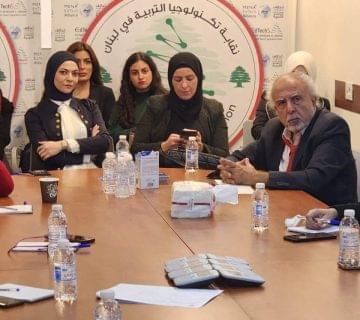
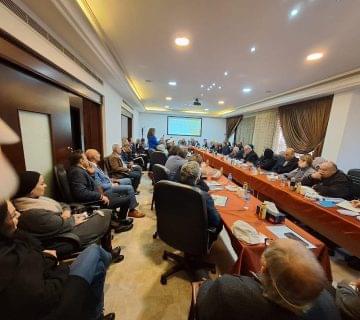
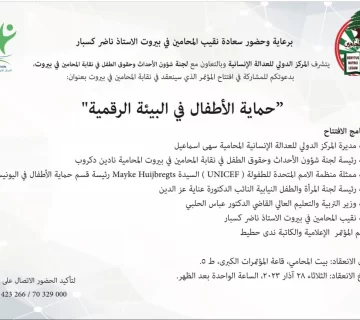
On 16/2/2023, the International Center for Humanitarian Justice HUMAN ACTION held a conference in the Bar Association under the sponsorship of His Excellency Captain of Barors, Mr. Nazir Kasbar, under the title:
“Digital transformation in Lebanon – opportunities and challenges”
The conference witnessed an opening session in which the captain of lawyers in Beirut, Mr. Nazir Kasbar, Director of the International Center for Human Justice Lawyer Soha Ismail, Chairman of the Information Technology Committee in the House of Representatives, Mr. Tony Frangia, Communications Minister Eng. Johnny Al-Quram and Chairman of the Group Dr. Talal Abu Ghazala International Dr. Talal Abu Ghazala, and the opening of a thinking and discussion workshop of four sessions discussed the following topics:
Electronic government and artificial intelligence
First session: The role of e-government in reducing the phenomenon of corruption
• Realistic and legal challenges of e-government
• The positive effects of e-government
Second Session: Digital Transformation and Artificial Intelligence in the Justice Sector
• The concept of artificial intelligence and the responsibility arising from its mistakes
• Artificial intelligence in justice sector (opportunities and challenges).
Human rights in the digital age
Third session freedom of expression and expression between cyberbullying and hate speech.
• The reality of cyber-bullying and hate speech in the digital age
• Legal and legislative regulations on freedom of expression and expression and their role in limiting bullying and hate speech.
The Fourth Session: Special Rights in the Digital Age.
• The right of intellectual property and legal and technological obstacles in its protection
• The right to privacy and protection of personal data
Lawyer Mr. Joseph Nahra, Lawyer Mr. Charbel Shabir, Judge Dr. Waseem Al-Hijar, Lawyer Dr. Amani Alaji, Captain of Education Technology Mr. Rabee Baalbaki, Judge Dr. Joseph Tamer, Lawyer Mr Rani Sader, Dr. Ataf Qamaruddin.
In conclusion, the scientific committee of the conference issued the following recommendations:
• Seeking to form an electronic shadow government;
• Updating Lebanese legislation related to informational laws in the light of technical and legislative developments and issuance of relevant decrees and applicable decisions;
• The push of the official authorities to give the update of the information sector and information laws in Lebanon an absolute priority as this forms the basis for the development of the country, enhancing transparency, efficiency in work and the fight against corruption;
• Securing the necessary credits to update the technical infrastructure of the IT and communications sector in Lebanon through the purchase of information equipment, licensing the software, and securing funds for its maintenance;
• Working on the application of e-government in Lebanon and securing services and transactions for public administrations and ministries through online platforms;
• Approval of applicable laws and decrees related to e-government;
• Training employees and beneficiaries on ways to deal and adapt to advanced technology and encourage them to make the most of it;
• The push of the official authorities to give the update of the information sector and information laws in Lebanon an absolute priority as this forms the basis for the development of the country, enhancing transparency, efficiency in work and the fight against corruption;
• Adoption of a system of strict liability for defects arising from the operations of the circular economy, including third party programs that have caused damage;
• Working on updating the rules of the Lebanese Consumer Protection Law and including artificial intelligence within its definitions;
• Join International BUDAPEST CONVENTION EYE 24l7;
• Activate the cyber security strategy and create the INTERVENTION IP CENTER;
• Developing and implementing the law, especially for SLA AGREEMENT WITH THE ISPS;
• Work to update intellectual property legislation in line with recent developments to support the economy and protect human rights;
• Necessity to keep up with the national legislation of model principles for personal data protection, that Bill 2075/2020, prepared by French experts with the participation of Lebanese experts in May / 2020/, its rulings were based on the European Parliament directive for the protection of personal data No. /2020/, this guidance has been recently cancelled and replaced by rules. The GDPR (General Data Protection Regulation) issued in 2016 (as we have previously mentioned) makes the Lebanese law referred to, lagging behind the best regulatory standards for information privacy;
• Adopting legislation regulating freedom of expression on social media and frankly criminalizing hate speech and bullying.
• Working on publishing a blog that includes ethics and behaviors of dealing with one another on social media;
• Include and adopt the principle of the right to education to innovation for all as a human rights right in Lebanon;
• Inclusion and participation of digital civil society organizations specialized in all official digital transformation committees;
• Promoting the culture of digital citizenship and raising the level of digital maturity;
• Adopts the principle of justice and sound digital governance;
• Protecting digital sovereignty and adopting work to promote the Sixteenth Sustainable Development Goals;
• Working to raise awareness of the citizens in Lebanon on the benefits of services provided by informational means;
• Work on encouraging the state to retain IT personnel with highly experienced, by giving them proper salaries and polarizing competencies for public administrations, as well as training staff and beneficiaries;
• Working on encouraging innovation, investments and education in the information sector in Lebanon;
• Working to bridge the digital gap between the developed world and developing (global) countries by directing e-government programs to classes unable to access government information and services, and securing educational and educational opportunities for those who do not have e-knowledge;
• Protecting information security by protecting cyber-government websites against hacker attacks and misuse;
• Continuous and continuous evaluation of security systems to ensure proper implementation of all security preventive measures.
The recommendations have been raised to his excellency MP Mr. Tony Frangiya, Chairman of the MP IT Committee, who lauded efforts made for the success of the conference.

No comment